Composition II
New to the collection: Floch’s large-format oil painting Composition II (Three Sisters) from 1951 was acquired for the Ysabel Sureth Collection (YSC) in 2022.
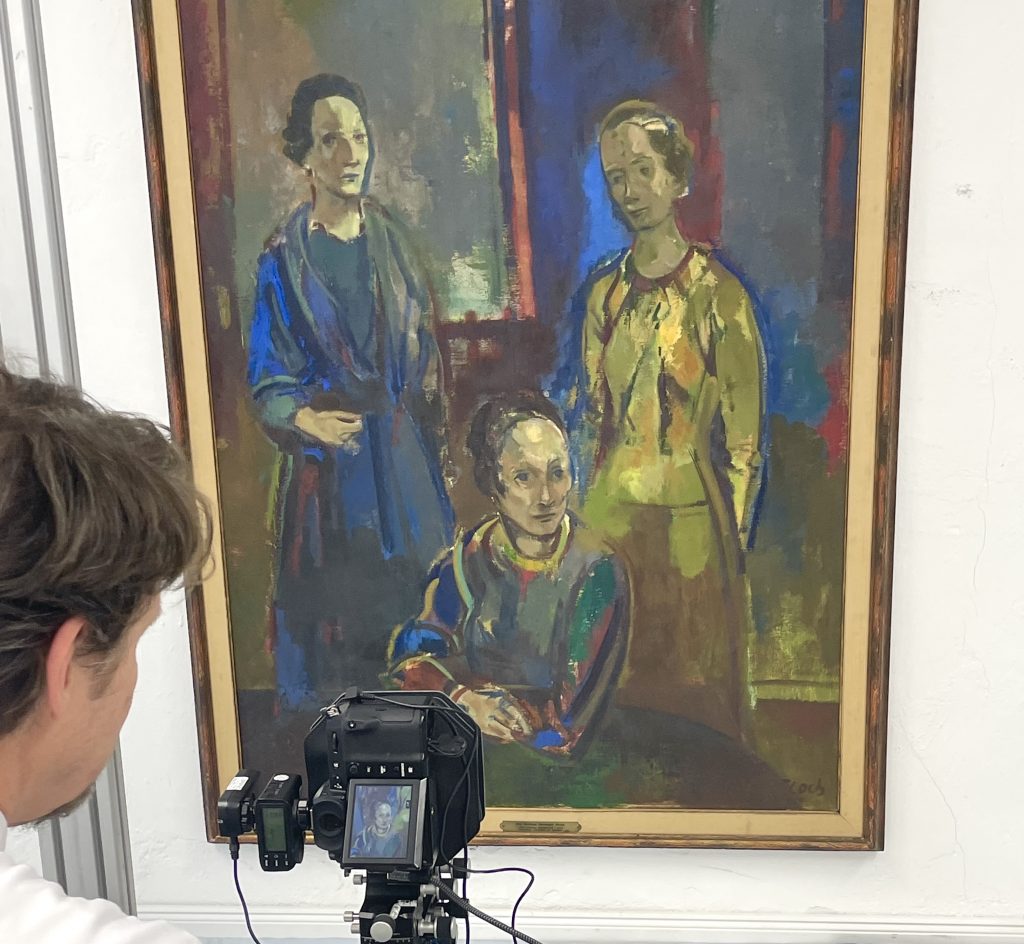
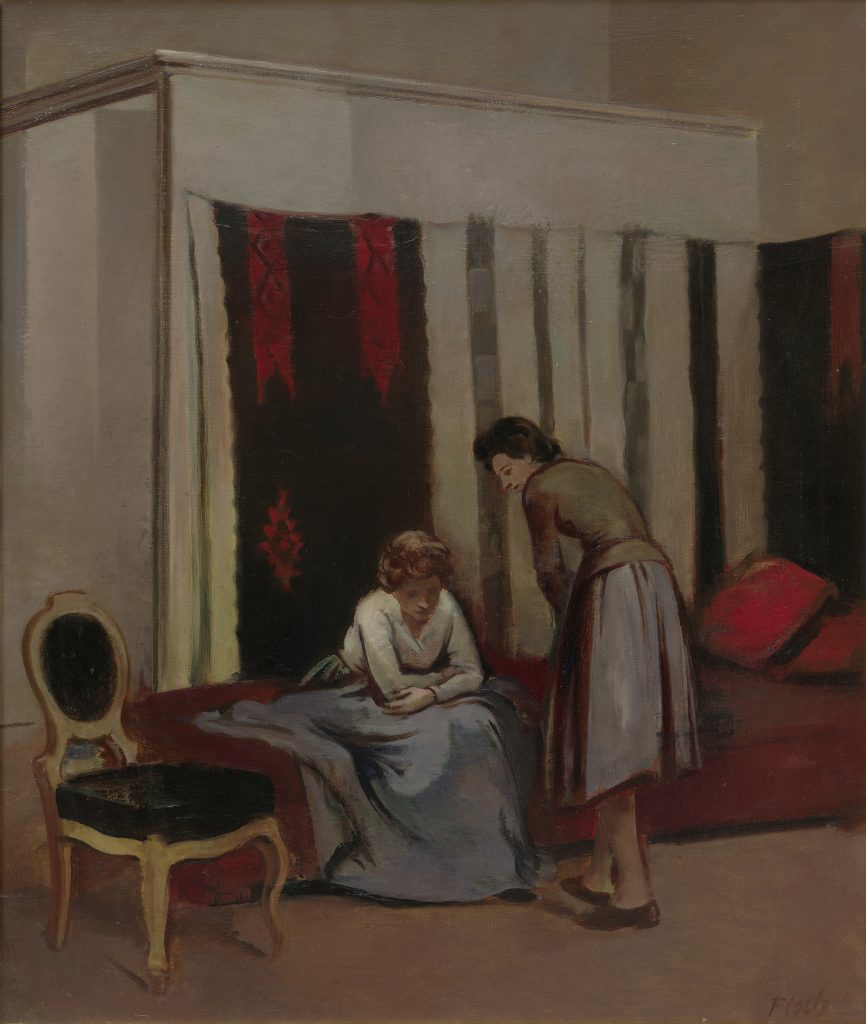
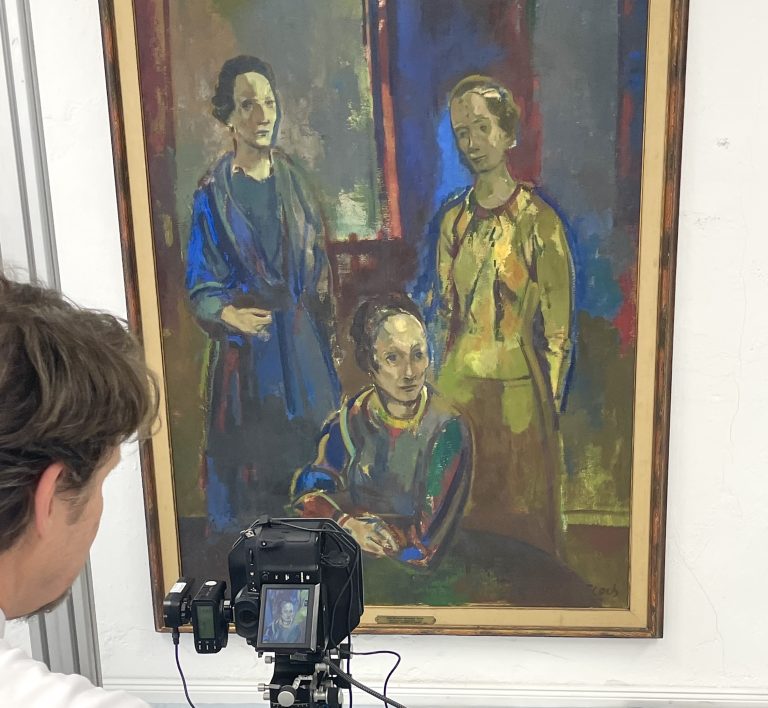
Three women gather around a table. Two stand in the background, while one sits in the foreground, her hands folded. They do not touch one another. The seated figure forms the centre. Whether they are three sisters, three generations, or three friends remains open. They are not visibly speaking. Their gazes do not meet. And yet a silent communication emerges — an inner familiarity is conveyed.
The faces are individually rendered: the younger, thoughtful profile on the right, the more mature countenance on the left, and the concentrated, almost listening figure in the foreground. All three are present. Their garments are set in flat passages, the contours soft yet firmly drawn. In the interplay between the vertical bands of the background and the calm triangular structure of the figures, that distinctive tension arises which characterizes Floch’s post-war work as a whole. The table forms a dark threshold: as viewers, we approach, almost at eye level with the seated figure. This painting draws us in through proximity, yet simultaneously denies entry. We are close — and yet one step outside the quiet circle.
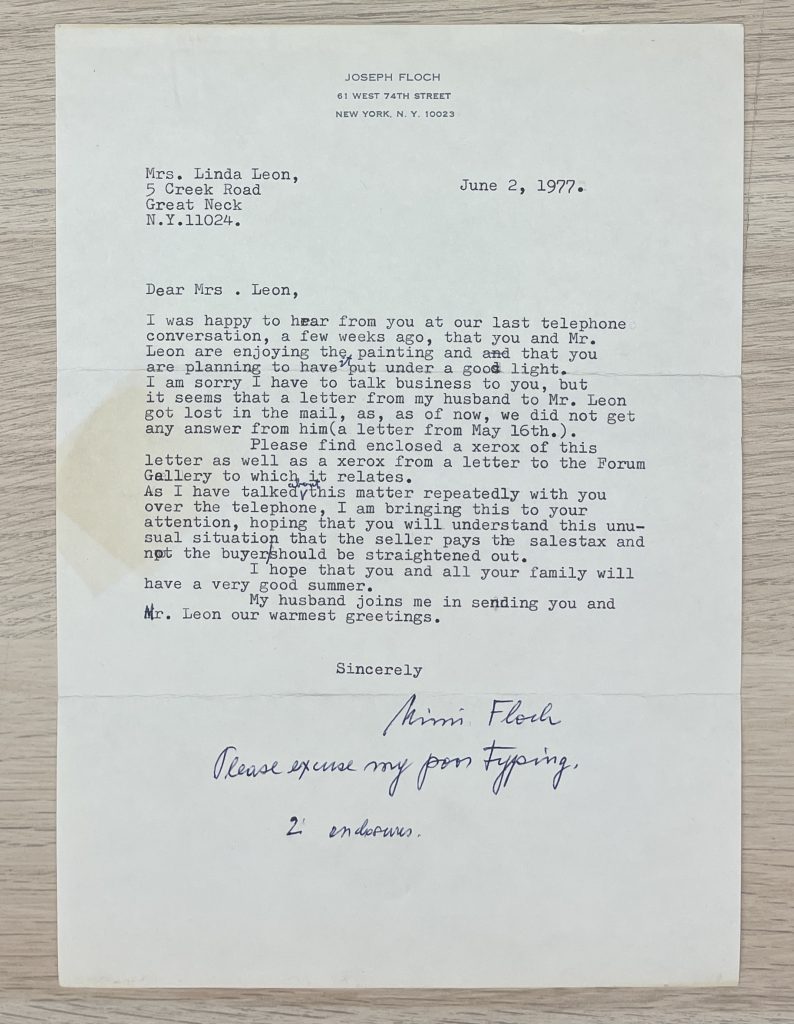
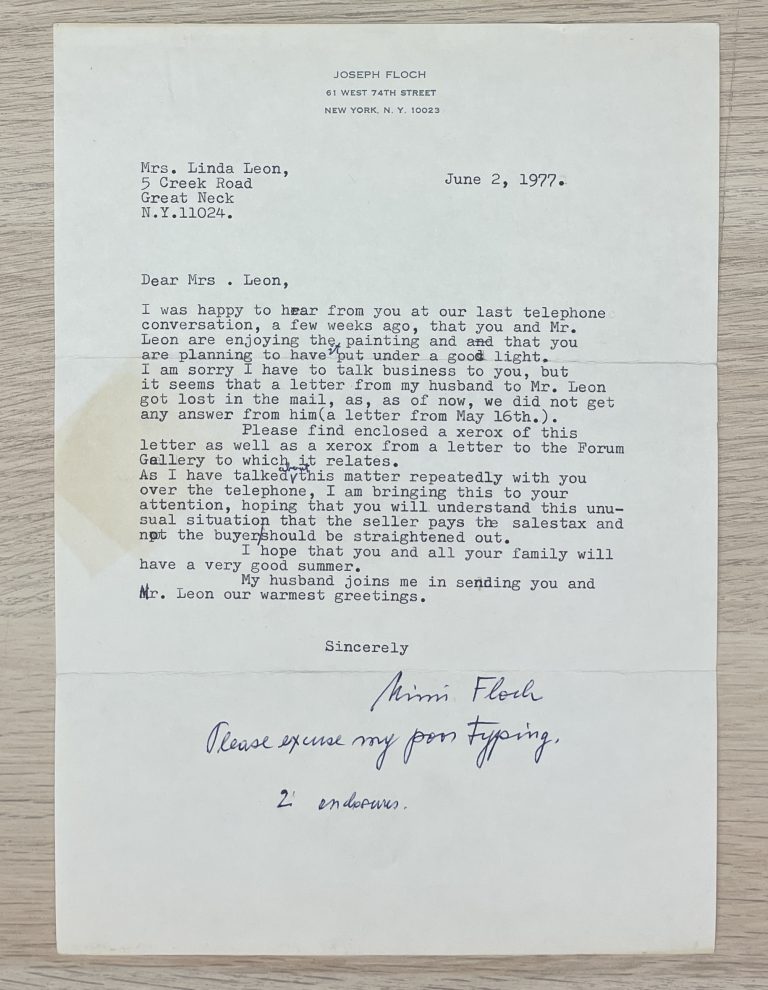
Two titles have been recorded: in the catalogue raisonné Karl Pallauf lists the painting as Composition II (cat. rais. no. 479), while in the body of correspondence available to us it is referred to as Three Sisters. The surviving correspondence from 1977 is revealing. It documents the sale of the painting through Forum Gallery, New York, to the collector couple Leon. We hold letters from Bella Fishko, from Josef Floch, and from Hermine (“Mimi”) Floch, supplemented by payment receipts and envelopes. The personal tone of the exchange between artist, gallery, and buyers becomes palpable. Hermine Floch expressly thanks the collectors for their understanding “for Joseph the artist and Joseph the man,” underscoring the close relational dimension of this transaction. For the YSC, the letters add a concrete art-historical layer to the painting: they document not only its provenance but also the market conditions of an established artist in 1970s New York, as a discrepancy between the sale price and the artist’s proceeds had to be discussed. 1977 is also the year of Josef Floch’s death. A newspaper clipping published by Bella Fishko publicly honours him, while condolence letters convey personal words. For us, artwork and documents together form a coherent historical ensemble.
Composition II (Three Sisters in letters between Floch and Forum Gallery, N.Y.C., 1977), 1951, oil on canvas, 134.8 × 100 cm, catalogue raisonné: Karl Pallauf, no. 479 (b/w ill. p. 300). Reproduction photography: Jörg von Bruchhausen.
02.06.1977 Letter from Mimi (Hermine) Floch to the collector Mrs Linda Leon (YSC-JF-DOC-AConv-3rd-out-003).


Composition II
New to the collection: Floch’s large-format oil painting Composition II (Three Sisters) from 1951 was acquired for the Ysabel Sureth Collection (YSC) in 2022.
Three women gather around a table. Two stand in the background, while one sits in the foreground, her hands folded. They do not touch one another. The seated figure forms the centre. Whether they are three sisters, three generations, or three friends remains open. They are not visibly speaking. Their gazes do not meet. And yet a silent communication emerges — an inner familiarity is conveyed.
The faces are individually rendered: the younger, thoughtful profile on the right, the more mature countenance on the left, and the concentrated, almost listening figure in the foreground. All three are present. Their garments are set in flat passages, the contours soft yet firmly drawn. In the interplay between the vertical bands of the background and the calm triangular structure of the figures, that distinctive tension arises which characterizes Floch’s post-war work as a whole. The table forms a dark threshold: as viewers, we approach, almost at eye level with the seated figure. This painting draws us in through proximity, yet simultaneously denies entry. We are close — and yet one step outside the quiet circle.
Two titles have been recorded: in the catalogue raisonné Karl Pallauf lists the painting as Composition II (cat. rais. no. 479), while in the body of correspondence available to us it is referred to as Three Sisters. The surviving correspondence from 1977 is revealing. It documents the sale of the painting through Forum Gallery, New York, to the collector couple Leon. We hold letters from Bella Fishko, from Josef Floch, and from Hermine (“Mimi”) Floch, supplemented by payment receipts and envelopes. The personal tone of the exchange between artist, gallery, and buyers becomes palpable. Hermine Floch expressly thanks the collectors for their understanding “for Joseph the artist and Joseph the man,” underscoring the close relational dimension of this transaction. For the YSC, the letters add a concrete art-historical layer to the painting: they document not only its provenance but also the market conditions of an established artist in 1970s New York, as a discrepancy between the sale price and the artist’s proceeds had to be discussed. 1977 is also the year of Josef Floch’s death. A newspaper clipping published by Bella Fishko publicly honours him, while condolence letters convey personal words. For us, artwork and documents together form a coherent historical ensemble.
Composition II (Three Sisters in letters between Floch and Forum Gallery, N.Y.C., 1977), 1951, oil on canvas, 134.8 × 100 cm, catalogue raisonné: Karl Pallauf, no. 479 (b/w ill. p. 300). Reproduction photography: Jörg von Bruchhausen.
02.06.1977 Letter from Mimi (Hermine) Floch to the collector Mrs Linda Leon (YSC-JF-DOC-AConv-3rd-out-003).