Die Ysabel Sureth Collection
– Josef Floch (1894–1977)

On this website, Ysabel Sureth presents her collection focused on the works of Josef Floch (1894-1977). The collection forms a remarkable ensemble spanning the creative period from around 1915 to 1971, tracing his journey through Vienna, Paris, and New York.
Since 1992, the Ysabel Sureth Collection (YSC) has placed particular emphasis on female portraits and figurative compositions. With cornerstone works on the one hand and previously unpublished discoveries on the other, the collection provides a rich insight into Floch’s artistic oeuvre. The depiction of women holds particular importance both in this private collection and throughout Floch’s body of work. We frequently encounter them in interiors that the artist rendered with increasing simplicity over the years.

The journey of this remarkable artist is marked by such works as the Fisherwomen and Harbor of Collioure, by landscapes captured from the then-novel jet perspective, followed by New York cityscapes and terrace scenes from a new period, as well as in still lifes, nudes, drawings, and self-portraits. A shared threat across all these works is their attentive stillness – a ‘silent conversation’ that demands presence. Or, as art historian Julius Held put it in 1968: “Amidst the deafening clamour of modern art, it is a relief to encounter a painter whose work is dedicated to the noble, if unfashionable, proposition that art should be seen, not heard.” (in: Karl Pallauf, Werkekatalog Josef Floch, p. 499)

The News section features newly acquired works accompanied by image commentaries, alongside updates and previews of the YSC. 

On the occasion of the 2024 collection presentation, a private inventory catalogue has been published. The volume includes an in-depth essay by Floch specialist Dr. Marianne Hussl-Hörmann, providing value context on his life and artistic legacy. 

Collectors of Floch’s work, scholars, and members of the specialist press are warmly invited to contact us should they wish to arrange a private viewing of the collection.

collector

Josef Floch

Inventory Catalogue

Collection Presentation
Die Ysabel Sureth Collection
– Josef Floch (1894–1977)

On this website, Ysabel Sureth presents her collection focused on the works of Josef Floch (1894-1977). The collection forms a remarkable ensemble spanning the creative period from around 1915 to 1971, tracing his journey through Vienna, Paris, and New York.
Since 1992, the Ysabel Sureth Collection (YSC) has placed particular emphasis on female portraits and figurative compositions. With cornerstone works on the one hand and previously unpublished discoveries on the other, the collection provides a rich insight into Floch’s artistic oeuvre. The depiction of women holds particular importance both in this private collection and throughout Floch’s body of work. We frequently encounter them in interiors that the artist rendered with increasing simplicity over the years.

The journey of this remarkable artist is marked by such works as the Fisherwomen and Harbor of Collioure, by landscapes captured from the then-novel jet perspective, followed by New York cityscapes and terrace scenes from a new period, as well as in still lifes, nudes, drawings, and self-portraits. A shared threat across all these works is their attentive stillness – a ‘silent conversation’ that demands presence. Or, as art historian Julius Held put it in 1968: “Amidst the deafening clamour of modern art, it is a relief to encounter a painter whose work is dedicated to the noble, if unfashionable, proposition that art should be seen, not heard.” (in: Karl Pallauf, Werkekatalog Josef Floch, p. 499)

The News section features newly acquired works accompanied by image commentaries, alongside updates and previews of the YSC. 

On the occasion of the 2024 collection presentation, a private inventory catalogue has been published. The volume includes an in-depth essay by Floch specialist Dr. Marianne Hussl-Hörmann, providing value context on his life and artistic legacy. 

Collectors of Floch’s work, scholars, and members of the specialist press are warmly invited to contact us should they wish to arrange a private viewing of the collection.
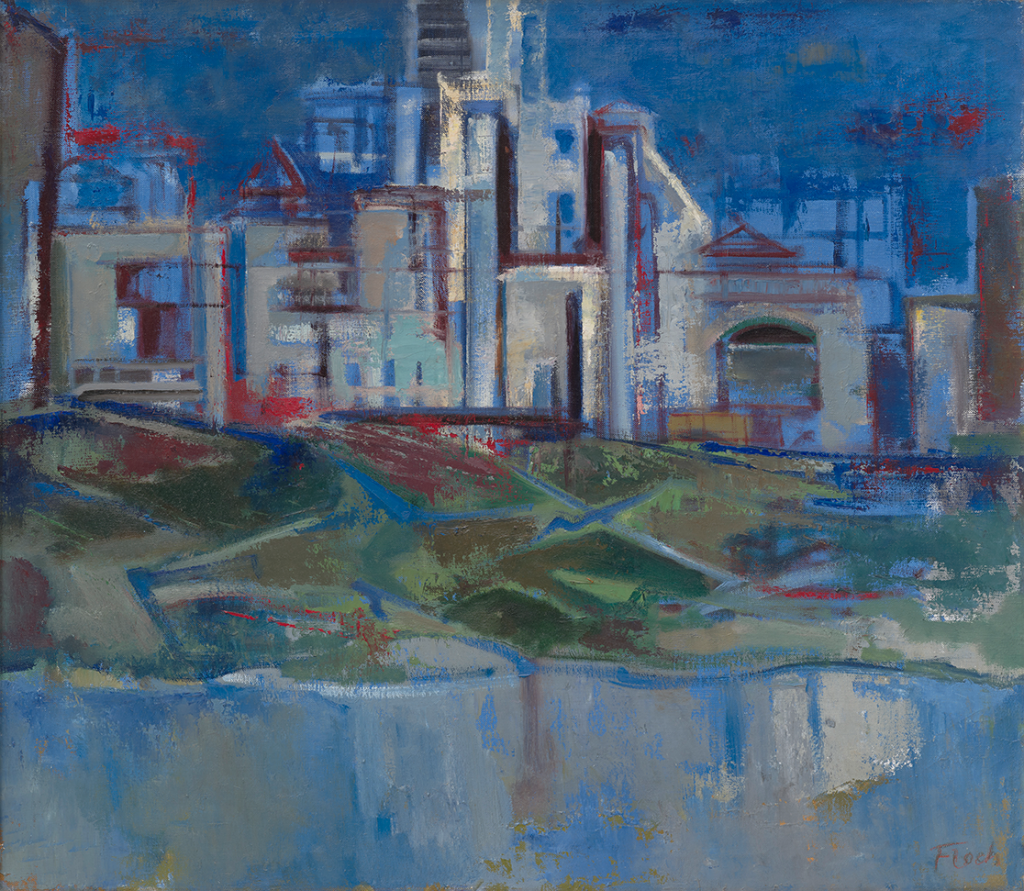
East River New York

Created 1968
Year of acquisition (YSC): 2024

Fifteen years later, Josef Floch offers a further perspective in East River, New York (1968). Here, the architectural density recedes in favour of a more open spatial conception, incorporating river water and riverbanks. The colouring is lighter, more powerful. The city no longer feels oppressive but is embedded in a larger landscape context. This late work demonstrates insight and clarity. 

Especially in comparison to the early French city and harbour scenes, such as the Hafen con Collioure (1927 / Port of Collioure), the change in Floch’s life becomes perceptible. Collioure opens onto the Mediterranean, is flooded with light, and is characterised by a sense of natural movement. In this setting, architecture, boats, and figures come together in a vibrant equilibrium. In New York, on the other hand, the city takes on the character of a constructed entity: dense, enclosed, and shaped by vertical and horizontal tensions. Biographically, this reflects Floch’s experience of exile, as in New York city, space, and people are transformed into a new visual language.

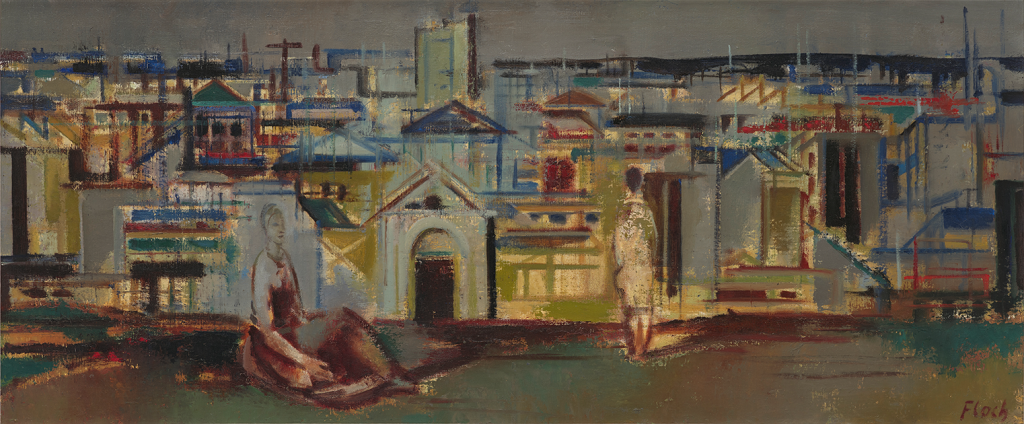
The City

Created 1953
Year of acquisition (YSC): 2020

The City (1953) is more complex – and enigmatic: architecture, streets, and building forms interlock, and the urban space appears fragmented. The two shadowy figures – seated, standing, in motion – are part of the scene, yet without true grounding. They appear less as agents acting within the city and instead seem somewhat detached, suggesting a quest for the parameters of human presence within a superordinate structure. In this painting, the city is not merely a setting, but a counterpart. Within the metropolis, Josef Floch seems to seek the positioning of quiet existences. Floch’s diary entry from 1952 formulates this almost programmatically: ‘The human being is the centre, and even the slightest trace of nature in a picture is like a sunbeam on a cold, dark winter day.’ (cited in Pallauf, p. 65)

Rooftops, New York

Created 1952
Year of acquisition (YSC): 2016

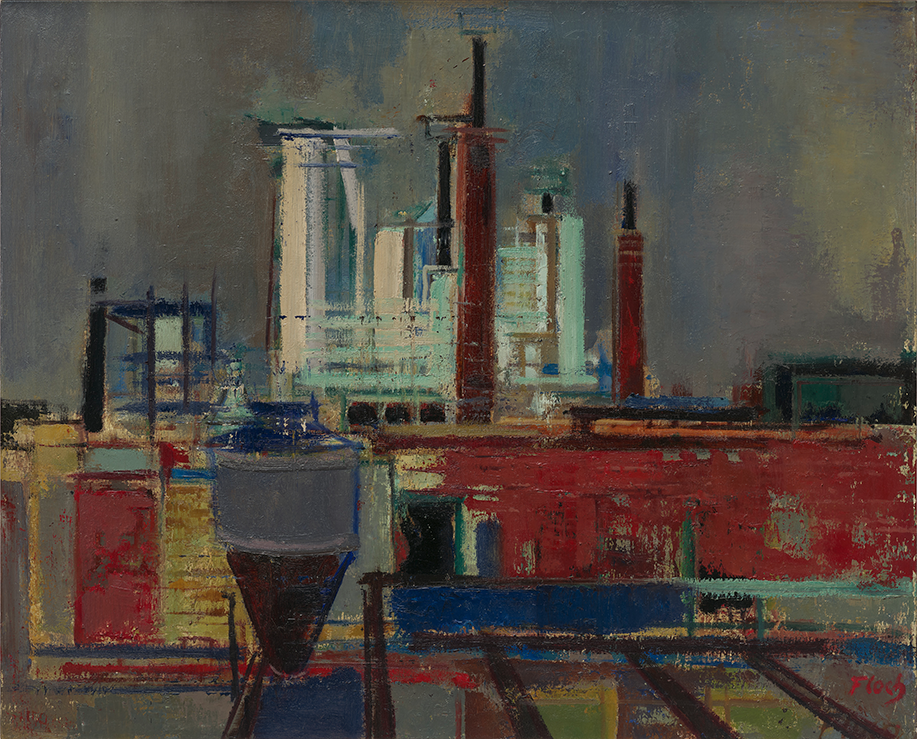
Through his New York cityscapes, Josef Floch’s perspective on the city as a lived environment becomes clear – a space in which human existence is structured by architecture. Colour conveys a sense of rhythm: in Rooftops, New York (1952), the eye is drawn to the roofscapes, technical installations, and vertical forms. No people are present. Colour and form are closely intertwined: cool blues and greys contrast with red and earthy ochre surfaces, while the composition maintaining a block-like, tension-filled structure.

Zwei Frauen im Gespräch

Created c. 1946
Year of acquisition (YSC): 2025

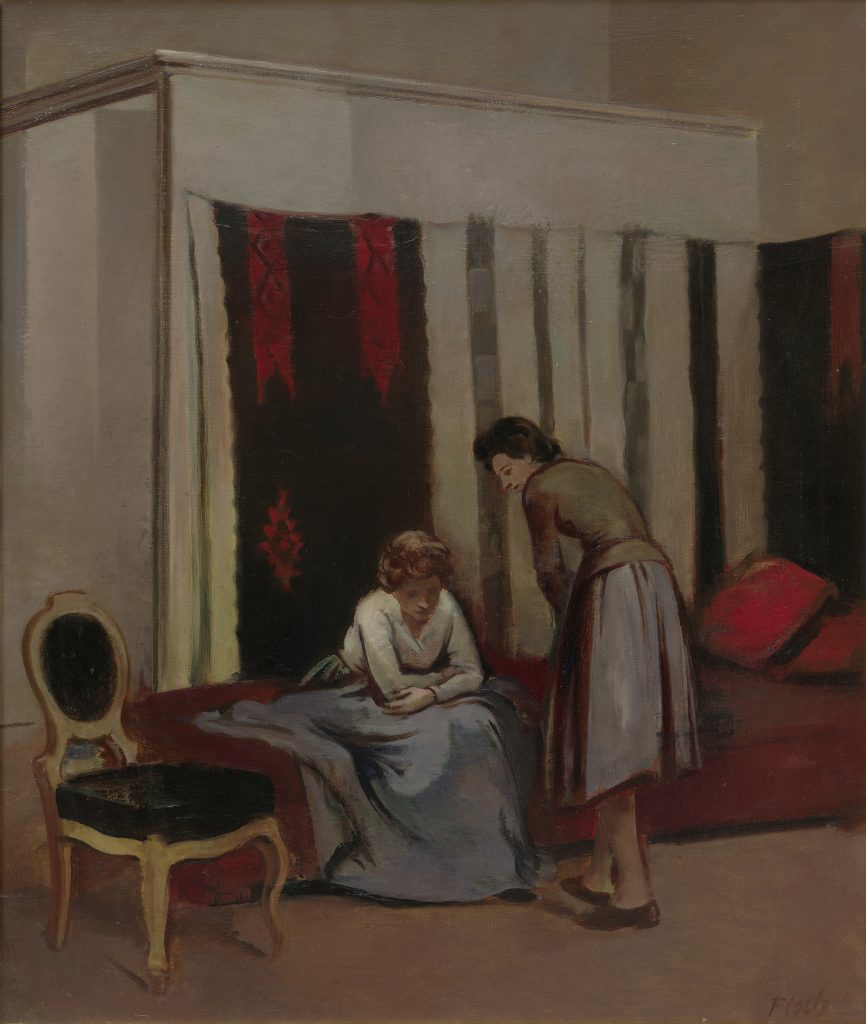
The painting Zwei Frauen im Gespräch (verso: Untitled) was created in the first years of Floch’s life in New York following his emigration, circa 1946, and belongs to a body of work in which he explores the interior as a primary site of human experience. In contrast to his later terrace or urban scenes, the space here does not open outward, but remains enclosed.

Two female figures are absorbed in a quiet moment: one is seated on the bed, her torso slightly inclined forward, hands folded, perhaps melancholic or fatigued; the other stands close by, turned towards her in an intimate manner. Muted shades of grey, brown, and ochre tie together the figures, the space, and a strikingly vivid red accent. The view, gently raised and pulled into the room, steers clear of a distanced central perspective. Floch works with skewed spatial axes: the bed is at a slight angle, and the edges of the walls do not strictly align. He evokes an intimate connection with the scene, implying that the room is a studio, possibly captured in a moment of pause. The empty chair in the foreground is set aside, waiting. It serves as a functional element in several depictions, for instance as the seat for the model in Collette (1943), Mimi mit Schal (1952 / Mimi with Scarf), and Woman with Mask (1957). Floch’s distinctive approach of interior space was immediately recognised by his contemporaries: At the 1947 Salon d’Automne in Paris, art critic Raymond Rey wrote, ‘Je ne connais pas un contemporain poignant une tele vision nouvelle de l’intérieur’ (quoted in Pallauf, p. 59: ‘I do not know of any contemporary artist who paints such an innovative vision of the interior’). This effect results from the relocation of the human figure within the space itself: the interior becomes a sounding board for inner conditions.

As early as 1941, Floch reached his first major successes in the USA, with his works shown at the Toledo Museum of Art (Ohio), followed by an exhibition at the Gallery of the Associated American Artist in New York in 1942, where he continued to exhibit regularly until 1956. From this point forward, he regularly participated in exhibitions in American museums, among them The New Americans at the American British Art Center, New York, in 1943; the Carnegie exhibitions in Pittsburgh, Pennsylvania, in 1944 and 1945; and European Artists in America at the Whitney Museum of American Art, New York, in 1945. In 1944, he was awarded the Walter Lippincott Prize for figurative painting. 

Junge Frau mit rotem Haarband,

Created c. 1942
Year of acquisition (YSC): 2016

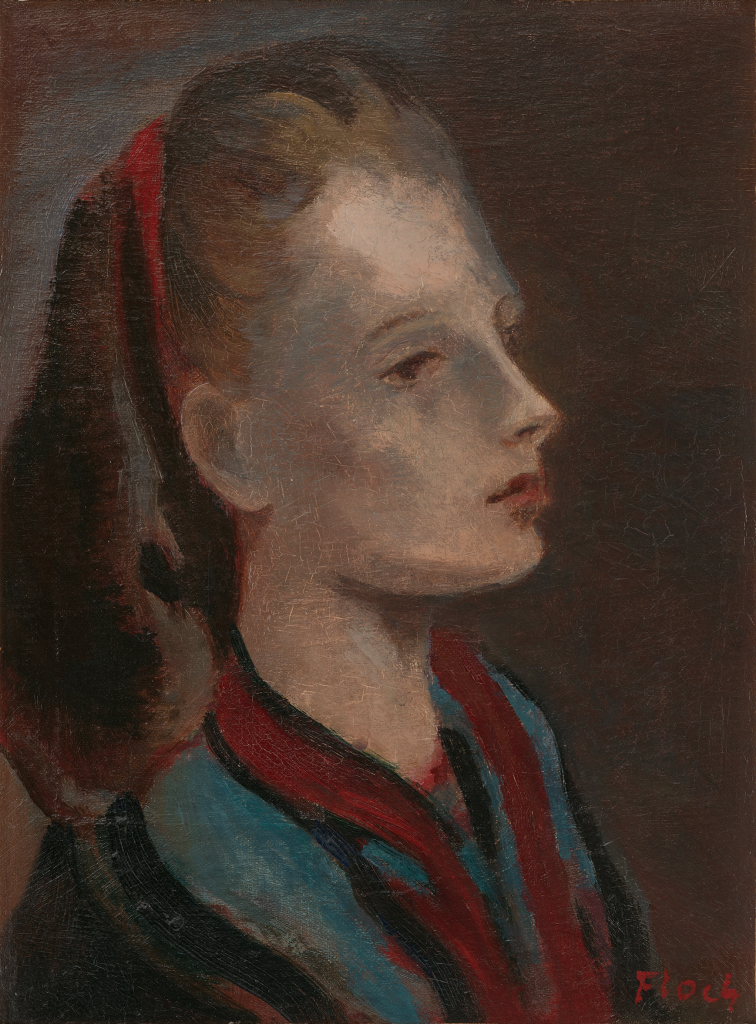
The portrait Junge Frau mit rotem Haarband was created during the early years of exile: in August 1941, Josef and Mimi Floch fled the National Socialists with their two daughters, travelling via Spain (Madrid, Seville) to New York. Crossing the Atlantic on the Navemar proved to be a catastrophic experience (as it was for Marc Chagall and around 750 others). In the United States, a new phase of working begins for Josef Floch, marked by external rupture, which, however, does not manifest in a stylistic radicalisation but rather reinforced his inner continuity. He resolutely maintains his figurative approach – now under conditions of existential uncertainty, political disillusionment, and cultural alienation, to the extent that he can only find harsh words for the contemporary American art scene he encounters in galleries and museums: ‘collapsing schizophrenic artistic tendencies’ (1942, Pallauf, p. 56). In his diary, Floch repeatedly wrote during those years about the necessity of not surrendering the ‘human’ as the central focus of painting. And it was in this situation that Junge Frau mit rotem Haarband came into being. She appears as a half-length figure in profile, her gaze directed slightly upwards and outwards. Her posture is calm, composed, and almost otherworldly. There is no direct contact with the viewer – the young woman appears introspective and, indeed, self-assured. Characteristic is the clear yet gentle contour of her profile. Floch avoids any psychologising intensification; he conveys the individuality of the sitter through her posture and inner tension, as well as through his modulation of colour: the red hairband is a detail that becomes a structuring device, rhythmically binding the head and directing our gaze. Surrounded by a muted palette of greys, blues, and earth tones, the red remains restrained within the composition. The scarcely defined background creates a quiet interior space in which the figure seems entirely self-contained. She becomes the bearer of a quiet, unobtrusive dignity.

Katalogseite
1/1

Hafen von Collioure

Created 1926
Year of acquisition (YSC): 2011

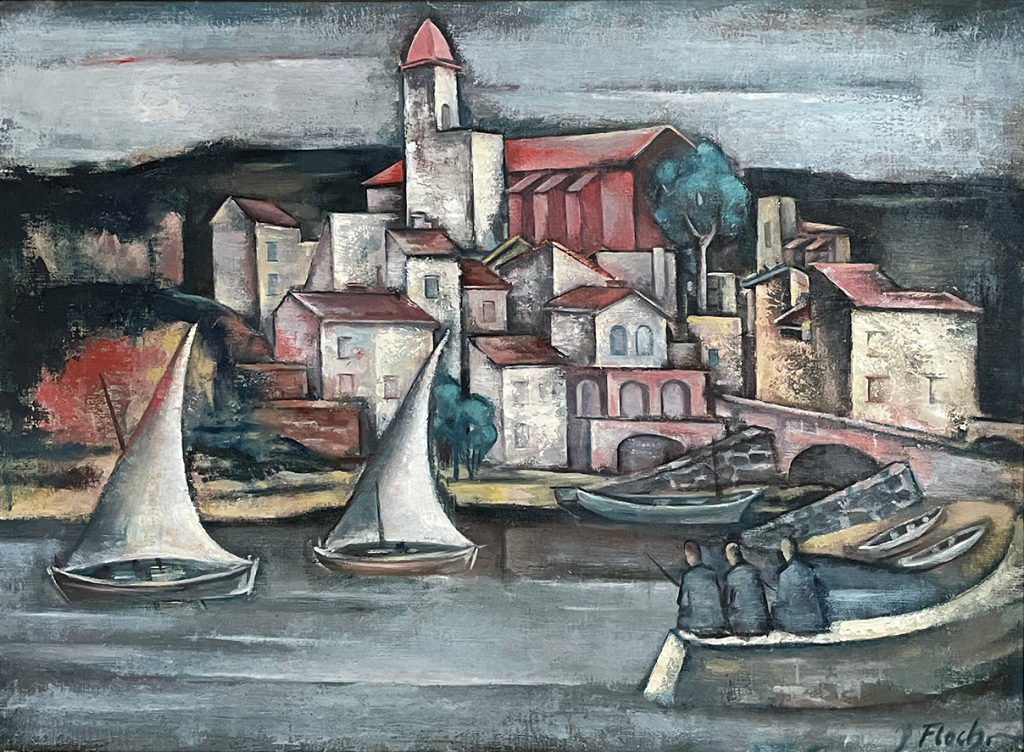
The painting Hafen von Collioure (1927 / Harbour of Collioure) extends this approach into the realm of landscape. The Mediterranean urban architecture with church and boats, with sailing vessels and figures on the quay in the foreground, is rendered in almost cubically structured blocks, while the sails become rhythmic planes. The colours are strong, yet more subdued than in Vienna. For Floch, Collioure was not only an inspiring place of work but also a symbol of inner clarification.

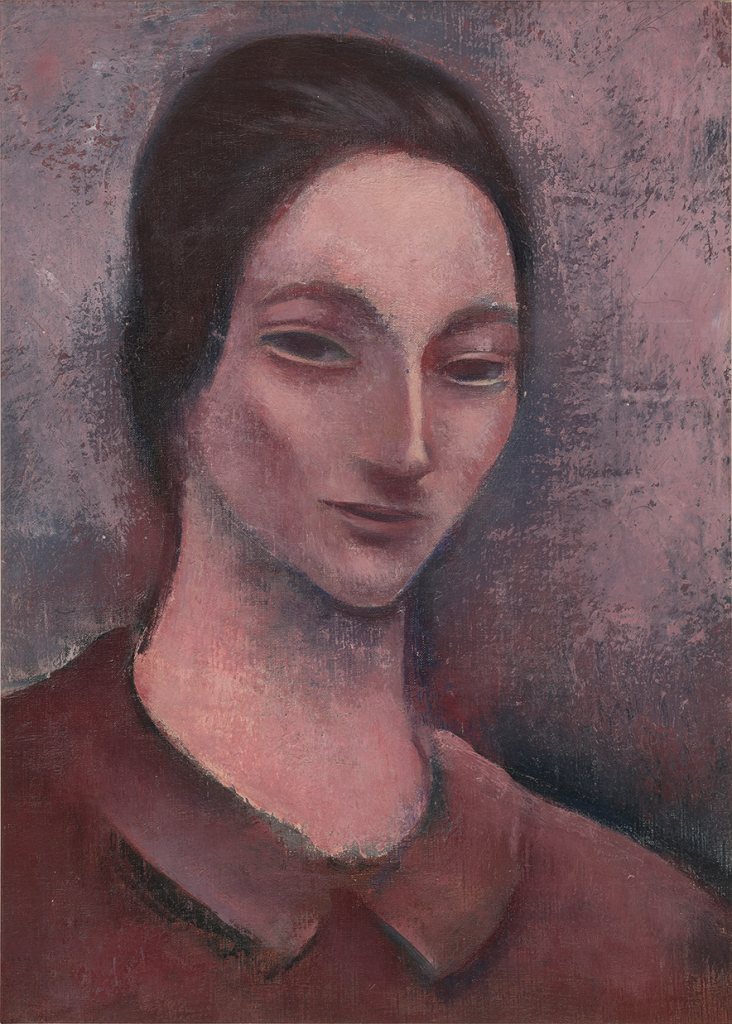
Mädchenkopf

Created 1926
Year of acquisition (YSC): 2012

The works Mädchenkopf (c. 1926 / Girl’s Head) and Fischersfrau aus Collioure (1926 / Fisherwoman from Collioure) mark the transition from the individual portrait to an abstract typological representation. Mädchenkopf depicts a half-length portrait of a young woman in a red blouse, set against a neutral background. The head is slightly tilted, the eyes almond-shaped, the facial features reduced, almost schematic. Warm reds and violets dominate the colour scheme. In contrast to the Mädchenkopf, the Fischersfrau aus Collioure has a more serious, almost stern expression, alluding to her working milieu. The paintings as a whole emphasise clear lines and block-like forms, and the female figures become strictly defined pictorial entities: archetypal, detached, in a colour scheme dominated by earthy reds and cool backgrounds. Floch himself wrote in his diaries that he gave greater importance to ‘inner composition’ than to the direct impression of nature.

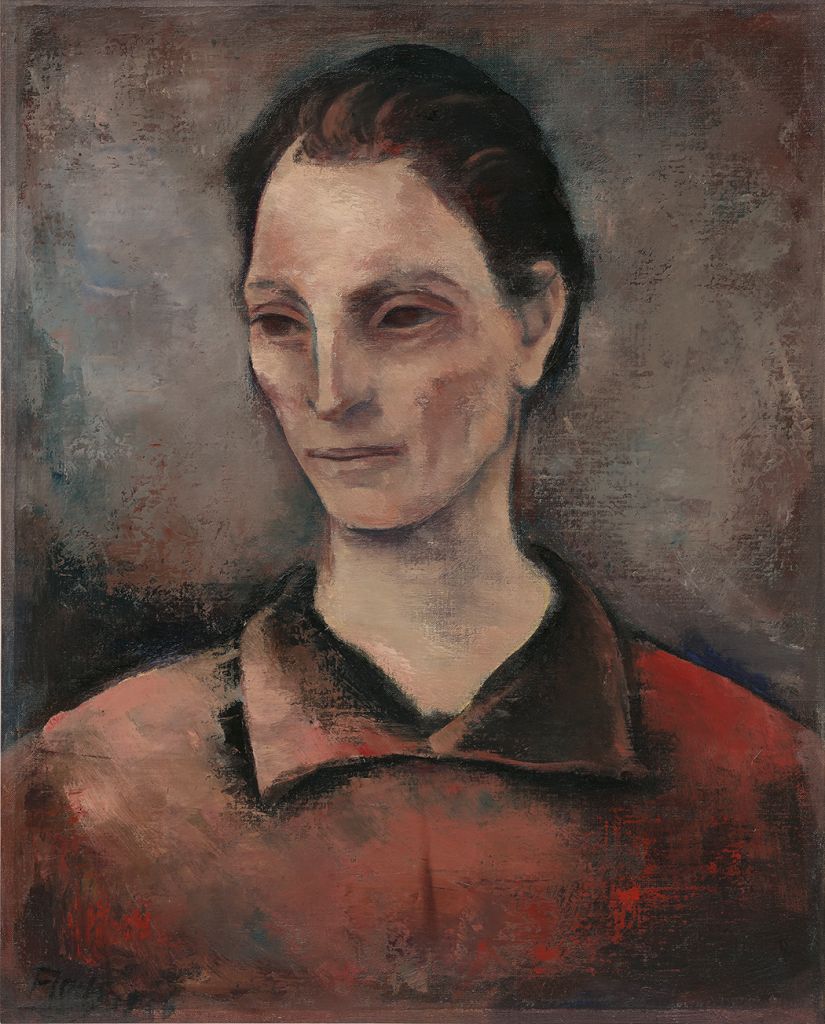
Fischersfrau aus Collioure

Created 1926
Year of acquisition (YSC): 2011

The works Mädchenkopf (c. 1926 / Girl’s Head) and Fischersfrau aus Collioure (1926 / Fisherwoman from Collioure) mark the transition from the individual portrait to an abstract typological representation. Mädchenkopf depicts a half-length portrait of a young woman in a red blouse, set against a neutral background. The head is slightly tilted, the eyes almond-shaped, the facial features reduced, almost schematic. Warm reds and violets dominate the colour scheme. In contrast to the Mädchenkopf, the Fischersfrau aus Collioure has a more serious, almost stern expression, alluding to her working milieu. The paintings as a whole emphasise clear lines and block-like forms, and the female figures become strictly defined pictorial entities: archetypal, detached, in a colour scheme dominated by earthy reds and cool backgrounds. Floch himself wrote in his diaries that he gave greater importance to ‘inner composition’ than to the direct impression of nature.

Wartende Frauen

Created 1935
Year of acquisition (YSC): 2001

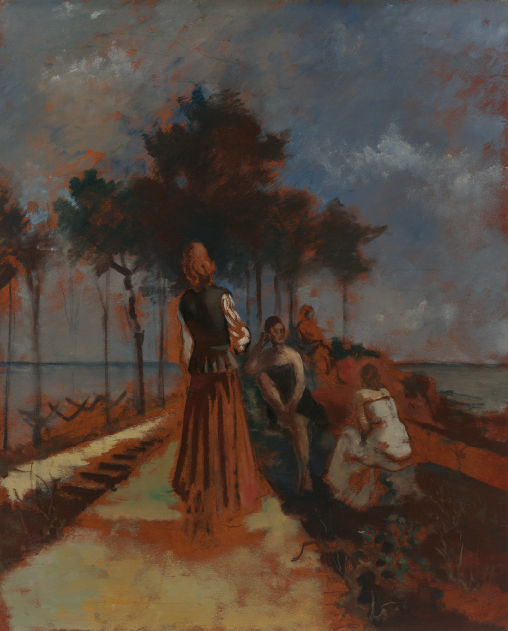
Similarly, though opened more strongly into the expanse of space, Floch works in the study Wartende Frauen (c.1935 / Waiting Women). Several female figures – seated, standing, seen from the back – are grouped along an avenue by the water. The composition remains visibly in process: a reddish-brown underpainting emerges, and individual figures are executed only fragmentarily. Here, too, the renunciation of individual physiognomy is decisive: the women appear as ‘anonymous bearers’ of a compositional idea, a group in quiet anticipation, whose posture speaks more to the structure of the image than to personal states of mind.

Wartende Akte vor einem Vorhang

Created 1928
Year of acquisition (YSC): 2025

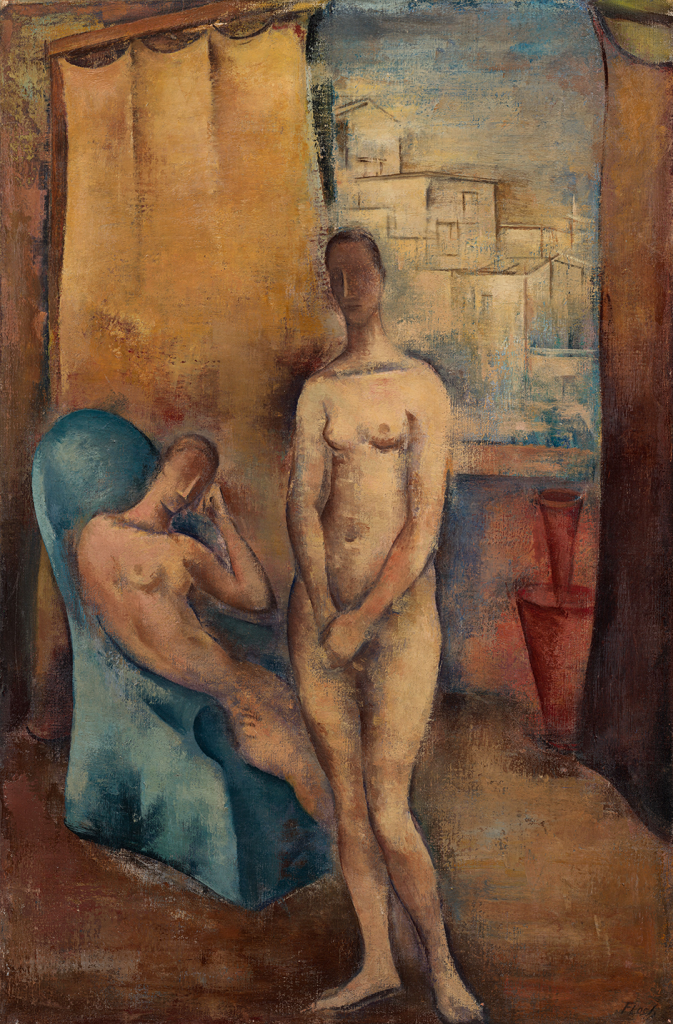
The painting Wartende Akte vor einem Vorhang (1928 / Waiting Nudes before a Curtain) characterises this new approach. Two female figures – one seated in an armchair, the other standing, facing front – appear not as individual characters but as types, their faces only schematically suggested. The heavy curtain, the vase, and the view onto a city silhouette frame the scene like a stage set. Here, Floch’s Parisian experiment with quiet stillness and architectural spatial arrangement becomes apparent: figures are no longer treated as portraits but set into a compositional balance that exudes inner tension.

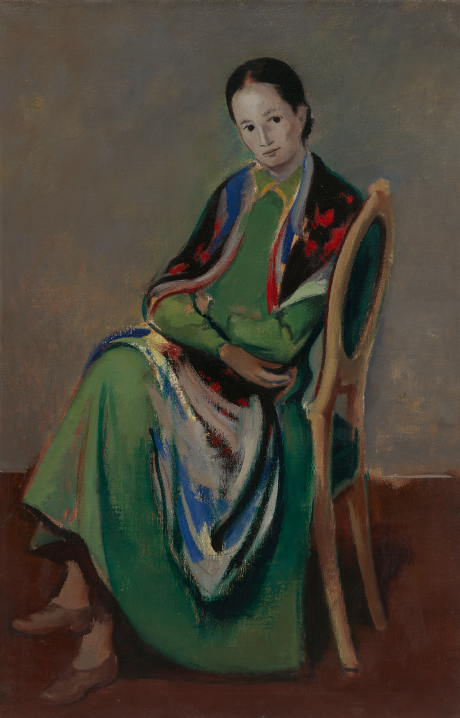
The Mädchenporträt

Created 1920
Year of acquisition (YSC): 2011

The Mädchenporträt depicts a seated young woman at half-length, oriented directly toward the viewer, with her hands loosely clasped. The composition is defined by cool blue and green tones, which are tempered by violet and yellowish inflections. Built up in layers of impasto, the surface takes on a vibrant texture. Against the blue background, the figure appears to almost glow. Clear contours and broadly treated areas point to Cézanne, whose work was a decisive point of reference for Floch in this period. The serious, composed gaze is accompanied by a barely perceptible, tentative smile – an understated expression that places the figure in a quiet tension between solemnity and gentleness. It becomes evident that Floch was less interested in the precise rendering of individual facial features than in a more universal pictorial conception of the human figure, for the merely suggested, minimally worked pupils and the calm statics allow the figure to appear chiefly as an embodiment of stillness, concentration, and subtle inner movement. The work thus signals a turn toward a more generalised, formally disciplined conception of the figure which Floch would go on to develop consistently after his journey to Israel and Egypt (1922) and his relocation to Paris (1925).

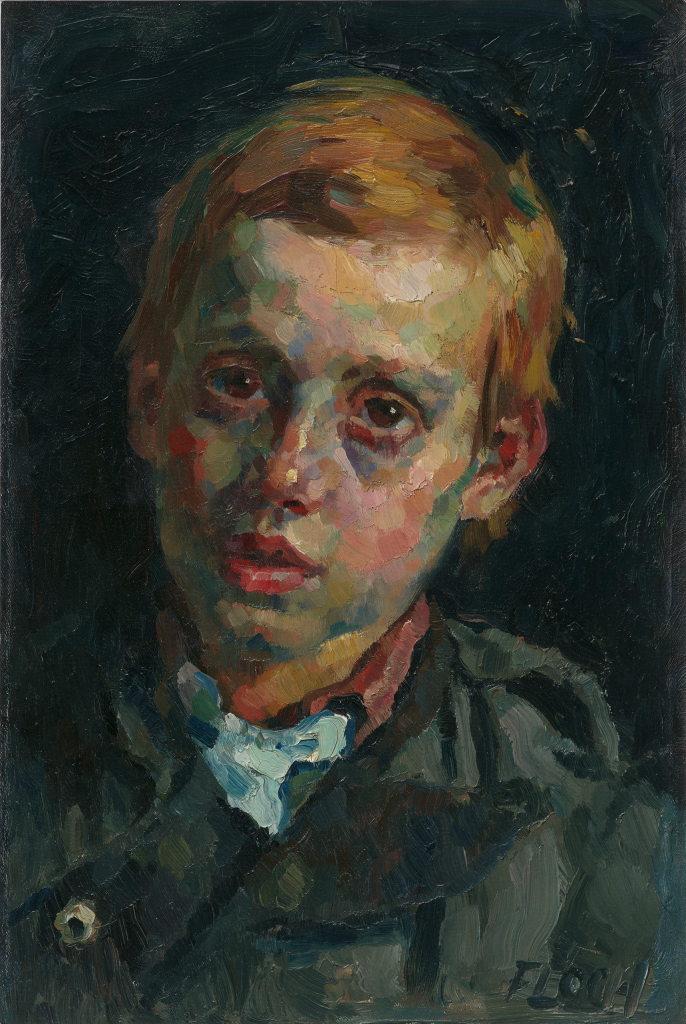
Boy’s Portrait

Created 1915–1920
Year of acquisition (YSC): 2018

The Bubenporträt was created during or shortly after Floch’s studies at the Vienna Academy (1913–1918). The painting depicts a boy shown half-length, with a slightly tilted head and a direct gaze, executed with pastose brushwork. The powerful, short applications of paint in muted green, brown, and ochre tones are contrasted with reddish highlights in the face. Floch’s early works still bear traces of Viennese late Impressionism and Expressionism, yet simultaneously they gain an inner intensity through his engagement with the Old Masters, particularly as a result of his journey to Holland in 1919. In its handling of light and the sculptural modelling of the face, the Bubenporträt reveals clear affinities with Rembrandt: as in the great character studies of the Dutch masters, the physiognomy emerges from a subdued, dark background and acquires an inner gravity. Already in the reduced rendering of the pupils and the cool, broken palette, Floch’s own stylistic signature becomes apparent, emphasising quiet stasis and timeless severity rather than psychological vitality. In 1919, he himself noted: ‘Played too much with colour – searching for a grand form without moving away from the genre.’ The Bubenporträt thus marks the moment at which the engagement with the Old Masters turns into an independent, modern visual language.